









June 30, 2023
Migration from IPv4 to IPv6 Issues – Challenges & Solutions
The migration from IPv4 to IPv6 is a topic of increasing importance as the exhaustion of IPv4 addresses looms. IPv4 has been the dominant protocol for Internet communication since its inception, but its limitations are becoming more apparent as the global demand for IP addresses continues to climb. Even though IPv6 offers several important advantages over IPv4, the transition from one protocol to another is not without its challenges. In this article, we will discuss the migration from IPv4 to IPv6 issues and how to get over them.
The Necessity to Migrate from IPv4 to IPv6
One of the primary reasons to migrate to IPv6 is the exhaustion of IPv4 addresses. IPv4 is limited to a maximum of 4.3 billion unique IP addresses, but the current number of internet-connected devices is far more than that. On the other hand, IPv6 has an address space of 128-bit that will provide practically an infinite number of unique addresses, thereby providing an adequate number of addresses even for future internet-connected devices. Thus, IPv6 will ensure the smooth and continued growth of the internet.
Additionally, IPv6 offers several advanced features that were not available in IPv4. Header extension, stateless address autoconfiguration, and improved security features are some of the new features that make IPv6 a more efficient and secure protocol. Also, IPv6 provides enhanced QoS (Quality of Service) and faster routing through the elimination of Network Address Translation (NAT). This will offer a better user experience and a more efficient network.
Furthermore, the migration to IPv6 is a worldwide initiative supported by various networking organisations and governments. Governments across the globe have already started promoting the usage of IPv6 and mandating a shift from IPv4. Many leading internet service providers have begun adopting and enabling IPv6, and numerous prominent websites and applications have already migrated to IPv6. Therefore, it is high time for enterprises to migrate to IPv6 to be compatible with the global standard.
Migration from IPv4 to IPv6 Issues
The Infrastructure
One of the primary issues with migrating to IPv6 is the sheer scale of the task. Given that IPv4 has been in use for over 30 years, millions of systems and devices rely on it for communication. Replacing all these systems with IPv6-compatible devices is an enormous undertaking that will require significant investments in time, resources, and expertise. This is particularly true for large organisations with extensive networks, who will need to ensure that all their hardware and software can handle the new protocol.
Compatibility
Another major issue with the migration to IPv6 is the fact that it is not backward-compatible with IPv4. While there are mechanisms in place to allow communication between the two protocols, these are often complex and can lead to issues with performance and compatibility. As such, organisations will often need to maintain both IPv4 and IPv6 systems in parallel during the migration process. This can lead to increased workload and operational complexity as teams need to ensure that both protocols are functioning correctly.
Network Management
Another issue with IPv6 migration is the need for appropriate network management tools and strategies. IPv6 is vastly more complex than IPv4, and as such, requires sophisticated management tools to ensure that networks are operating efficiently and securely. Organisations will need to invest in training and development to build up their capabilities in this area, which can be a substantial barrier to entry for smaller companies.
Slow Adoption
Finally, there are issues related to the wider adoption of IPv6. Although IPv6 has been available for many years, its adoption rate has been relatively low, with many organisations still relying on IPv4. This can lead to problems with interoperability and communication between different networks, particularly in cross-border scenarios. As such, there is still some work to be done in terms of increasing awareness and encouraging the adoption of IPv6 across the wider internet.
IPv4 to IPv6 Migration Techniques
Dual-Stack Deployment
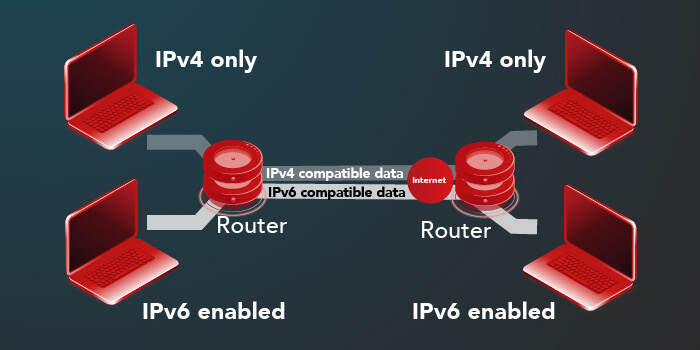
One of the most common techniques for IPv4 to IPv6 migration is called dual-stack deployment. This approach involves running both IPv4 and IPv6 on the same network simultaneously. This allows devices that are not yet compatible with IPv6 to continue using IPv4, while devices that are capable of using IPv6 can do so. The dual-stack deployment also ensures that any IPv4-only servers or applications can still function while IPv6 is gradually introduced.
Tunnelling
Another technique for IPv4 to IPv6 migration is the use of tunnelling protocols. Tunnelling allows IPv6 traffic to be carried over an IPv4 network. There are several tunnelling protocols available, including 6to4, Teredo, and ISATAP. These protocols encapsulate IPv6 packets within IPv4 packets, allowing them to traverse IPv4-only networks. However, tunnelling can result in latency and security concerns, which organisations need to take into account when implementing this technique.
Translation Technology
Another approach that can simplify IPv4 to IPv6 migration is the use of translation mechanisms. This technique allows IPv6-only devices to communicate with IPv4-only devices through address translation. There are several types of translation mechanisms, including Network Address Translation IPv6 (NAT64) and Address Family Transition Router (AFTR). These mechanisms allow IPv6 networks to communicate with IPv4 networks seamlessly, minimising disruptions during the migration process.
In conclusion, migration from IPv4 to IPv6 issues needs to be urgently addressed by organisations across all sectors. While the advantages of IPv6 are clear, the transition process is complex and will require significant investment to ensure a smooth transition. By carefully planning and managing the migration process, companies can ensure that they can take advantage of the many benefits of IPv6 and remain competitive in an increasingly connected world.
Recent News

Blockchain Technology: Revolutionizing IP Management
October 30, 2024

Understanding IPv4Mall’s Trusted Partnerships
October 26, 2024


Recent Comments